

Acupuncture for Dogs and Cats
Acupuncture is the treatment I am asked for most often. I use it for dogs and cats from the practice in Great Chart, just outside Ashford in Kent. The most sought after treatments are for arthritis, back pain, and animals who have started to slow down. This however is only a fraction of its uses. Most ailments can be treated with this modality. It can be used complementary to conventional medicine and often results in reduction of dosages and side effects.
What is Veterinary Acupuncture?
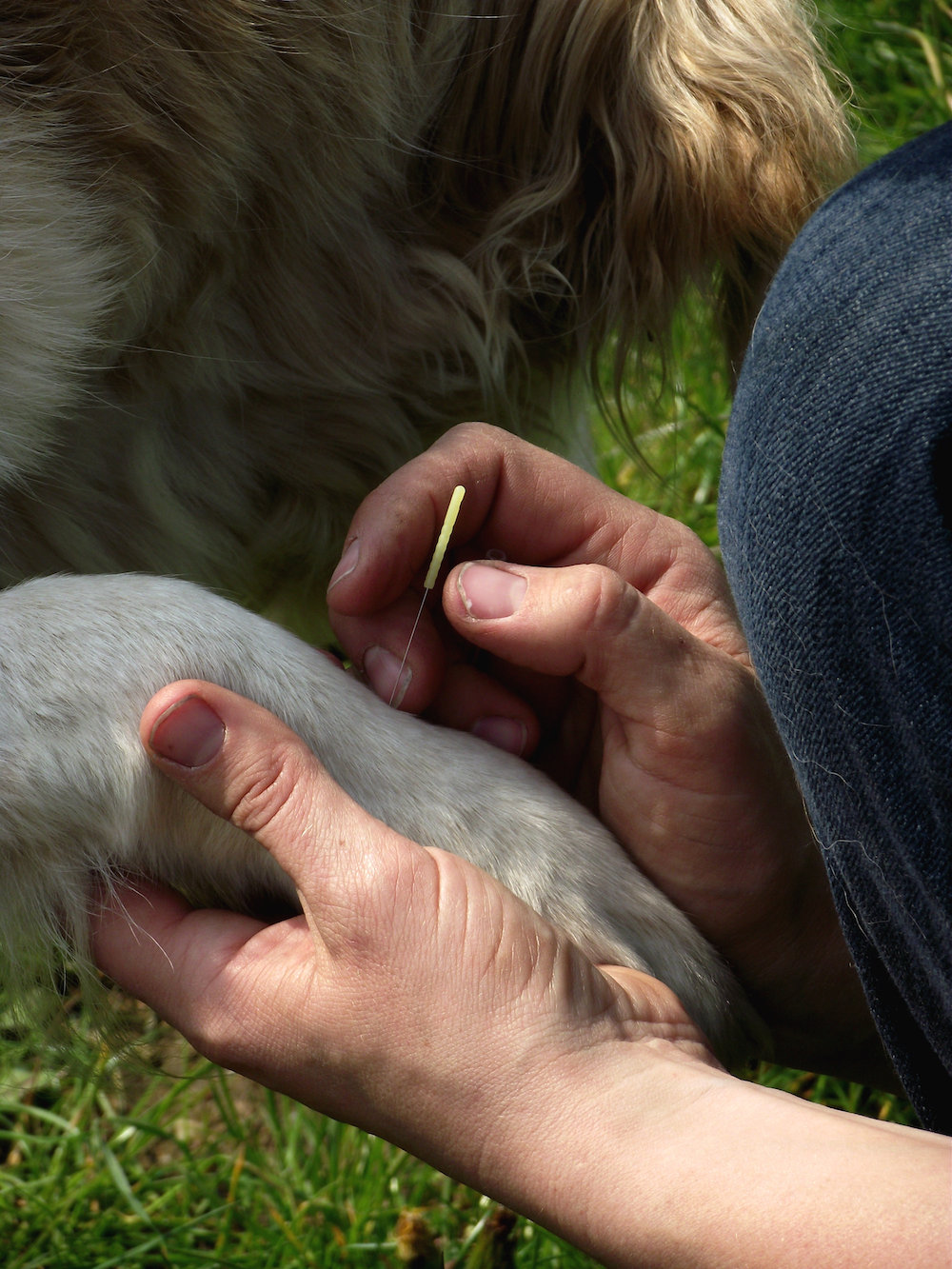
Veterinary acupuncture is a treatment that involves inserting fine, sterile, stainless steel needles into specific points of the body to induce a healing response. The treatment evolved over 3000 years ago in China and it is now being used in veterinary and medical practices throughout the world. Veterinary acupuncture is increasingly being recognised as a useful treatment for a wide range of conditions. Inserting acupuncture needles stimulates tiny nerve endings that carry impulses to the spinal cord and brain. This results in responses within the nervous and endocrine systems, leading to the release of neurotransmitters and hormones. These influence the function of the body tissues and organ systems.
The effect of an individual needle is determined by where it is placed in the body and which nerves are stimulated – hence the need for a thorough knowledge of veterinary anatomy and physiology.
Initially, veterinary acupuncture increases the release of natural painkillers such as endorphins, enkephalins and serotonin which act on the pain pathways in the brain and spinal cord and can block the transmission of incoming pain signals. Then secondly in the mid-brain, veterinary acupuncture causes switching and reduced inhibition of the posterior horn cells via non-opiates, the monoamines. The third level comprises the core areas of the hypothalamus, where beta-endorphin is released.
Veterinary acupuncture can be used to treat all types of pain; it has been used in particular for pain affecting the musculoskeletal system. Acupuncture can also be applied in the treatment of chronic internal ailments. A list of ailments for which acupuncture can be effectively employed has been published by the World Health Organisation.
In general, the insertion of acupuncture needles into the skin is not painful. Some animals have very sensitive skin and react to the needles nervously or with trembling skin. As a rule, animals react increasingly calmly and trustingly as the treatment progresses. When felt necessary and beneficial I will replace the needles with a special medical Laser. This works particularly well in scared or behavioural patients.

What a session involves
The first appointment is longer than the ones that follow, because I go through the clinical history, diet, exercise and home environment. Treatment starts at the initial consultation.
Your animal stays with you throughout. Most dogs and cats settle within a few minutes and a good number fall asleep. The needles are far finer than the ones used for injections and most animals barely register the needle going in. If an animal is anxious or does not want to be touched, I use a medical laser instead of needles to the same effect. Most animals will let me needle them even if initially scared. It is important to me that they feel relaxed and cared for when in my practice, so I will always let them choose the pace.
The frequency for the follow up appointments depend entirely on their response, nature of disease and urgency of treatment. Some need weekly sessions to begin with, others come every few weeks to month once more established. The aim is always to space appointments out as things improve, but to not decline before coming back.
Veterinary Acupuncture for Dogs
The most common problems which makes people think about acupuncture for their dog’s are arthritis, spondylosis and intervertebral disc disease (hernia). Arthritis secondary to trauma, hip dysplasia, torn cranial cruciate ligament and elbow dysplasia are all commonly seen in my practice. Muscular skeletal problems can occur through too much exercise for young dogs or puppies, poor feeding- particularly at a young age, poor genetics, breed related weaknesses and repetitive trauma. For pain and orthopaedic patients veterinary acupuncture works on the pain perception of the dog, tender muscles, Myofascial and nerve response to either localised or generalised pain. It relieves the dog of pain and physical restrictions through compensational mechanisms. This enables us to bring the body back towards physiological movement where possible. However that is just one of the benefits of acupuncture
In fact, most diseases and ailments found in dogs can be treated with veterinary acupuncture and Traditional Chinese Herbs, these include:
- Skin problems for example lick granulomas, Histiocytoma and allergic dermatitis, recurrent ear infections
- Gastrointestinal problems such as IBD, diarrhoea, loss of appetite or vomiting of unknown origin
- Cancer treatment
- Palliative care
- Respiratory problems
- Behavioural problems
- Pain Management
- Musculoskeletal problems, such as arthritis, intervertebral disk disease, or traumatic nerve injury
Find out more about our veterinary acupuncture for dogs at Chirovet.
Veterinary Acupuncture for Cats
Cats tolerate acupuncture surprisingly well. As we all know cats are their own person and usually don’t rely on anybody. I have found that they embrace the treatment incredibly well and are very responsive to it. For patients that don’t like to be touched I use laser acupuncture, which works without insertion of needles. The most common problems I see in cats are skin problems, cancer treatment and lameness. Reasons for seen problems can be age related, husbandry or poor breeding, some poor cats just had a bad start to life.
For pain and orthopaedic patients acupuncture works on the pain perception of the patient, tender muscles, Myofascial and nerve response to either localised or generalised pain. It relieves the cat of pain and physical restrictions through compensational mechanisms. This enables us to bring the body back towards physiological movement where possible. At the same time I use the acupuncture to balance the body and address imbalances throughout the body and mind.
Arthritis in cats is worth mentioning here and is more common than one thinks. Cats hide pain far better than dogs so little signs like not jumping on the worktop, changed grooming patterns can be a sign for arthritic pain rather than an obvious limp. Please get in touch if you are not sure.
What acupuncture costs
The first consultation is longer and is charged at a higher rate than follow-up appointments, because it includes the full assessment as well as the treatment itself. Follow-up sessions are shorter and cost less. Most pet insurers will cover acupuncture when it is carried out by a qualified veterinary surgeon, please refer to your specific policy as they do differ.
Please email chirovetkentltd@gmail.com for a price list and further details.
Veterinary Acupuncture for Horses
Competition horses taking part in a wide range of disciplines are prone to developing minor injuries that often go unnoticed. Eventually these build up and cause the horse to compensate by altering its way of moving which makes it susceptible to more serious injury. Acupuncture has a valuable role as a preventative treatment. If unaddressed compensations build up and alter the physiological movement of the horse. This makes the horse susceptible to more serious injury.
Regular examination and treatment throughout the training/ season can catch these injuries at an early stage. Regular treatment help to keep the physiological movement, normal blood supply and elasticity of the muscles, they heal quickly and competition schedules are uninterrupted. Acupuncture does have a much broader use in equine medicine, it helps with digestive issues, management of the frequent equine colic, weight loss, respiratory problems gynaecological problems as well as behaviour issues.
In equine practice, veterinary acupuncture is commonly used together with chiropractic for the relief of musculoskeletal pain. It is especially useful for treating:
- Any type of muscle soreness, particularly of the neck, shoulders, back and hindquarters
- Cold backs – resentment of saddling and girthing, dipping on mounting
- general stiffness, inability to bend on one or both reins
- Head tilt, inability to flex from the poll
- Shortness of stride, not going forward from the leg
- Disunited or bunny-hopping at canter
- Moving un-level behind
- ‘Hopping’ on the transition from walk to trot
- Bucking on the transition from trot to canter
- Irritability and soreness during grooming
- Arthritis
- Sacroiliac pain
- Headshaker syndromes.
Acupuncture is also used to influence the function of internal organs.
- Respiratory problems
- Dermatological problems
- Gynaecological problems in mares, including infertility
- Poor immunity and post viral lethargy
- Digestive problems including loss of appetite, diarrhoea and some types of colic
Find out more about our veterinary acupuncture for horses at Chirovet.
Acupuncture for Animals
I have treated Pigs, Cattle, Sheep, Chicken, Rats and Ferrets however horses, dogs and cats are my most regular clients. Generally all animals benefit from acupuncture treatment to balance their body systems. As every species has its own characteristics I have found that each individual has got their unique pattern within the species. For example: Rabbits often suffer from digestive issues, I would see rats mainly for cancer treatment, and cattle for fertility support.
Where we are and who we see
The practice is at Great Chart, a couple of minutes outside Ashford in Kent, with parking on site. Owners bring dogs, cats and horses to us from across Kent and the wider South East, including London, Ashford, Canterbury, Maidstone, Folkestone, Tenterden and the surrounding villages. Horses can be seen at their yards with prior arrangement.
If you are not sure whether acupuncture would suit your animal, please ring or email us.
Frequently Asked ‘Veterinary Acupuncture‘ Questions
At Chirovet, acupuncture can be used as part of a treatment protocol for almost any medical condition with very little exception. It is often used in combination with conventional veterinary treatment so the patient experiences the benefits of the combined effects. In equine practice, acupuncture is commonly used together with chiropractic for the relief of musculoskeletal pain.
Acupuncture has many ways of working in the body, depending on the pattern. As an example I will explain what it does when it is used for the treatment of pain. Initially, acupuncture increases the release of natural painkillers such as endorphins, enkephalins and serotonin which act on the pain pathways in the brain and spinal cord and can block the transmission of incoming pain signals. Then secondly in the mid-brain, acupuncture causes switching and reduced inhibition of the posterior horn cells via non-opiates, the monoamines. The third level comprises the core areas of the hypothalamus, where beta-endorphin is released. Acupuncture can be used to treat all types of pain; it has been used in particular for pain affecting the musculoskeletal system.
Acupuncture is a treatment that involves inserting fine, sterile, stainless steel needles into specific points of the body to induce a healing response. The treatment evolved over 3000 years ago in China and it is now being used in veterinary and medical practices throughout the world. In veterinary medicine, acupuncture is increasingly being recognised as a useful treatment for a wide range of conditions.
Traditional Chinese Medicine conceives illness as being caused by disturbances in an organism’s energy balance. The purpose of acupuncture is to resolve and relieve these imbalances and energy obstructions, and thus effect healing. No distinction is drawn between physical and psychological conditions, rather diagnosis is based on both components as a whole. Obstructions to the flow of energy can be caused by a force acting from outside, overexertion, wrong diet, excess or unequal strain, and insufficient exercise, as well as neural factors. If such energy obstructions remain unrecognised and unresolved for any length of time, they can lead to pathological and anatomical changes for example arthritis.
In general, the insertion of acupuncture needles into the skin is not painful. Some animals have very sensitive skin and react to the needles with trembling skin or are not sure. As a rule, animals react increasingly calm and trusting as the treatment progresses. In some cases, a laser can be used to replace the needle.
Acupuncture is one of the safest forms of medical treatment for animals when it is administered by a properly trained veterinary surgeon. Side effects of acupuncture do exist but they are rare. An animal’s condition may appear changing for up to seven days after a treatment. Other animals become lethargic or sleepy for 24 hours. These effects are an indication that some physiological changes are developing, and they are most often followed by an improvement in the animal’s condition.
Acupuncture should never be administered without a proper veterinary medical diagnosis and an ongoing assessment of the patient’s condition by a veterinary surgeon. This is very important because acupuncture is capable of masking pain or other clinical signs and therefore could delay proper veterinary medical diagnosis once treatment has begun. Elimination of pain may lead to increased activity on the part of the animal, thus delaying healing or causing the original condition to worsen.
In general, acupuncture can be effectively combined with most conventional and alternative therapies. Certified Veterinary Acupuncturists have the comprehensive training, knowledge and skill to understand the interactions between different forms of treatment and to interpret the patient’s response to therapy.
Health can be defined as a state of harmony of an animal with its internal and external environment. Health is complete physical, mental and social well-being and not merely the absence of disease.
An acupuncturist who practises Traditional Chinese Medicine will look at the whole animal and not just the diseased part. Consideration will be given to why the disease developed in the first place. This is why it is important for the first examination to take place with the animal in calm surroundings. It is important that a conventional Western medical diagnosis has been obtained prior to the commencement of acupuncture treatment. For example, it is natural for an animal with pain in its front legs and no discernible lameness to develop back pains. In this case, the back is the secondary problem. It is therefore first of all necessary to treat the pain in the front legs, but as well to include the compensatory mechanism: the back. A conventional medical diagnosis is required to determine the cause of the lameness. A Traditional Chinese diagnosis is performed complementally.
The application of acupuncture is always subject to limitations when mechanical obstructions exist or organs have undergone irreparable change.
In general, the insertion of acupuncture needles into the skin is not painful. Some animals have very sensitive skin and react to the needles nervously or with trembling skin. As a rule, animals react increasingly calmly and trustingly as the treatment progresses. In some cases, a laser can be used to replace the needle.
The first consultation is longer and is charged at a higher rate than follow-up appointments, because it includes the full assessment as well as the treatment itself. Follow-up sessions are shorter and cost less. Most pet insurers will cover acupuncture when it is carried out by a qualified veterinary surgeon, please refer to your specific policy as they do differ.
Please email chirovetkentltd@gmail.com for a price list and further details.
No, you can book directly. I will ask for your animal’s medical history with your permission, so that I have access to all the information and performed diagnostics of your conventional practice or referral center.
Great Chart, just outside Ashford in Kent, with parking on site. Owners travel to us from across Kent and the South East. Horses can be seen at our practice or at their own yard.
(Verkhratsky A, Burnstock G. Biology of purinergic signalling: Its ancient evolutionary roots, its omnipresence and its multiple functional significance. Bioessays 2014;36:697–705. doi:10.1002/bies.201400024)
(Burnstock G. Purinergic signaling in acupuncture. Science 2014.)